
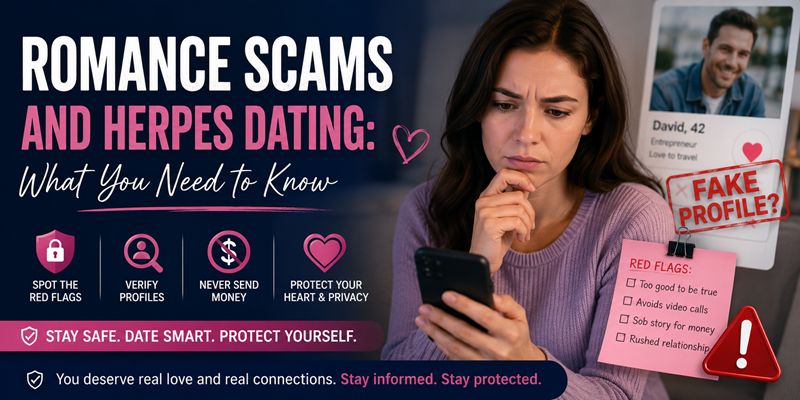
Online dating can make it easier to connect with people who understand your experiences, including others who live with herpes. But like any online dating environment, HSV dating sites can also attract fake profiles and romance scammers.
For people dating with herpes, the emotional side of meeting someone online can sometimes make scams particularly difficult to recognize. A person may appear understanding, supportive, and interested in your experiences before eventually asking for money, personal information, or other favours.
Knowing the warning signs can help you protect your privacy, finances, and emotional well-being while enjoying online dating.
What Is a Romance Scam?
A romance scam happens when someone creates a false identity or misrepresents themselves online to develop an emotional or romantic relationship with another person for financial or personal gain.
The Federal Trade Commission says romance scammers commonly create fake profiles, build trust over time, and eventually make requests for money. Common stories can involve medical emergencies, travel expenses, family problems, or investment opportunities.
The FBI similarly warns that scammers may appear genuine and caring while gradually building trust before asking for money or sensitive information.
These scams can happen on mainstream dating platforms as well as niche dating communities.
Why HSV Dating Scams Can Feel Different
Dating with herpes can involve conversations about privacy, disclosure, relationships, and vulnerability.
A scammer may attempt to use those emotions to build trust quickly.
For example, someone might claim to have herpes themselves and immediately emphasize how comfortable they are with your diagnosis. They may repeatedly tell you that they understand what you’re going through and that you can trust them.
Being supportive isn’t itself a warning sign. The concern comes when emotional intimacy develops unusually quickly and is followed by requests for money, personal information, explicit images, or other favors.
The important lesson is simple:
Shared health experiences do not automatically prove that someone is genuine.
Common Red Flags in HSV Dating
They Become Emotionally Intense Very Quickly
A new match saying they like you is normal.
A stranger immediately talking about marriage, lifelong commitment, or being your perfect partner can be different.
Romance scammers often try to establish trust quickly. The FBI recommends slowing down, asking questions, and being cautious when someone appears unusually perfect or pushes the relationship forward too quickly.
Give a new relationship time to develop naturally.
They Always Have a Reason They Cannot Meet
One of the clearest warning signs is a person who repeatedly promises to meet but always has another excuse.
They may claim to be working overseas, traveling for business, dealing with a family emergency, or experiencing another situation that prevents an in-person meeting.
The FTC and FBI both identify repeated inability or unwillingness to meet as an important warning sign.
Distance itself isn’t proof of a scam. Consistent excuses combined with other red flags are what should make you cautious.
They Quickly Want to Leave the Dating Platform
Some people naturally prefer texting or another communication method after getting to know each other.
However, be cautious when someone immediately pressures you to leave the dating site, especially before you’ve established trust.
The FBI specifically warns about people who quickly attempt to move conversations away from dating platforms.
If someone insists that you communicate privately so they can avoid the platform’s safety systems, moderation, or reporting tools, consider that a warning sign.
They Ask for Money
This is one of the biggest red flags.
A person you’ve never met may suddenly need help with medical expenses, travel, rent, legal problems, family emergencies, or another urgent situation.
They may also ask you to send cryptocurrency, gift cards, wire transfers, or money through an app.
The FTC’s advice is straightforward: never send money or gifts to an online love interest you haven’t met in person.
Your sympathy should never be used as a reason to ignore financial boundaries.
Be Careful With Personal Information
Romance scammers aren’t always looking only for money.
They may also attempt to collect personal information that can be used for identity theft, manipulation, harassment, or other fraud.
Avoid sharing sensitive information such as banking details, passwords, account recovery codes, government identification numbers, or other information that could compromise your accounts.
When dating with herpes, privacy can be particularly important. Think carefully before sharing identifying information about your workplace, home address, family members, medical records, or other sensitive details.
Don’t Let Herpes Become a Shortcut to Trust
Finding someone who understands herpes can feel reassuring.
You may feel an immediate connection when another person says, “I understand exactly what you’re going through.”
That connection can be meaningful, but it shouldn’t replace standard online dating safety practices.
Ask questions.
Take your time.
Look for consistency between what the person says and what they do.
Consider whether their profile information makes sense and whether their stories remain consistent over time.
A shared HSV experience can create common ground, but genuine trust should still develop gradually.
Check Their Photos and Profile
A profile photo can be copied from another person’s account.
The FTC recommends using reverse image searches when you suspect a romance scam. If a profile photograph appears under a different name or is connected to unrelated information, that can be a significant warning sign.
You can also search the person’s profile for information and compare it with what they’ve told you.
This doesn’t prove someone is a scammer, but inconsistencies deserve attention.
Be Careful With Intimate Photos
Online relationships can become intimate quickly.
Before sending private or explicit images, consider whether you genuinely trust the person and understand the potential consequences.
The FBI warns that scammers may request inappropriate photos or financial information that could later be used for extortion.
Once an image is sent, you may lose control over where it goes.
Taking things slowly can protect you from unnecessary risk.
Talk to Someone You Trust
Romance scams work partly because scammers encourage secrecy.
If a new online relationship is moving extremely quickly, talk to a trusted friend or family member.
An outside perspective can sometimes identify warning signs that are difficult to see when you’re emotionally involved.
The FTC specifically recommends talking with someone you trust if you suspect a new romantic connection may be a scam.
You don’t have to share every private detail. Simply explaining the situation can help you think more clearly.
What to Do If You Suspect a Scam
If you believe someone you met through an HSV dating site is attempting to scam you, don’t try to prove yourself or negotiate with them.
Stop communicating if necessary and report the profile through the dating platform.
If you have already sent money, contact your bank, payment provider, or financial institution as soon as possible. The FTC recommends reporting romance scams through ReportFraud.gov, while the FBI directs victims to its Internet Crime Complaint Center, IC3.
Being scammed can feel embarrassing, but there is no reason to blame yourself. These criminals deliberately manipulate trust.
Safe HSV Dating Starts With Healthy Boundaries
Dating with herpes can lead to meaningful relationships, friendships, and connections with people who understand your experiences.
You don’t need to become suspicious of everyone you meet online.
Instead, practice balanced caution.
Be open, but don’t rush.
Build trust, but verify important information.
Enjoy the connection, but maintain your boundaries.
And never let romantic feelings pressure you into sending money or revealing sensitive information.
The healthiest online relationships are built gradually. Someone who genuinely cares about you should respect your boundaries, understand that trust takes time, and never make financial demands a condition of the relationship.
Final Thoughts on Romance Scams and Herpes Dating
Romance scams can happen to anyone, including people using specialized HSV dating platforms.
The strongest protection is awareness.
Watch for rushed emotional commitment, inconsistent stories, repeated excuses for avoiding an in-person meeting, pressure to move conversations elsewhere, requests for private information, and especially requests for money.
Most importantly, remember that someone’s willingness to accept your herpes status doesn’t automatically make them trustworthy.
Let trust develop through consistent behavior over time.
You deserve a dating experience where honesty, privacy, respect, and genuine connection come first.
Frequently Asked Questions
How can I tell if an HSV dating profile is fake?
Look for inconsistent information, stolen or reused photos, unusually fast emotional attachment, limited willingness to meet, and pressure to move conversations away from the dating platform. These signs don’t prove fraud individually, but several together deserve caution.
Should I send money to someone I met on an HSV dating site?
No. The FTC recommends never sending money or gifts to an online love interest you haven’t met in person.
Can someone fake having herpes to gain my trust?
Yes. Someone can claim almost any identity or personal experience online. Shared HSV status should be treated as something to discuss, not as automatic proof of someone’s identity or intentions.
What should I do if someone asks for my financial information?
Don’t provide it. Never share banking credentials, passwords, verification codes, or other sensitive financial information with an online romantic connection.
How can I safely meet an HSV dating match?
Take your time getting to know the person, consider verifying their identity through reasonable means, meet in a public location, arrange your own transportation, and tell someone you trust about your plans.
Editorial Note: This article provides general online dating safety information and is not legal or financial advice. Safety practices and reporting procedures may change, so readers should consult official resources for the latest guidance.