
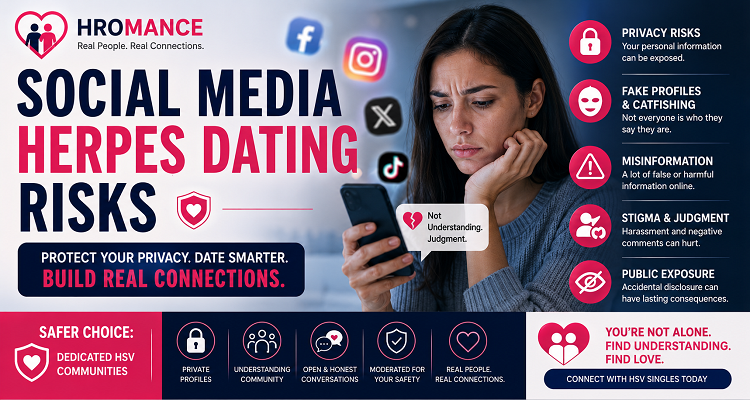
Social media has changed the way people connect, communicate, and build relationships. While platforms like Facebook, Instagram, TikTok, and X can help people meet others, they may not be the safest option for individuals living with herpes.
Many HSV-positive singles turn to social media hoping to find understanding, friendship, or romance. Unfortunately, these platforms often come with privacy concerns, stigma, misinformation, and emotional risks that can make dating more challenging.
Understanding the potential social media herpes dating risks can help you make safer choices while building meaningful connections.
The Illusion of Connection on Social Media
Social media creates the feeling that everyone is connected. You see profiles, photos, comments, and stories—it all feels personal. But that connection is often surface-level.
When it comes to why social media is bad for herpes dating, the biggest issue is this:
it’s not built for safe, honest, or private conversations about sensitive health topics.
People curate their lives online. They show highlights, not truth. And when you’re trying to build something real—especially with disclosure involved—that kind of environment works against you.
Instead of meaningful connection, you often get:
- Misleading identities
- Performative conversations
- Lack of emotional accountability
That’s not a solid foundation for any relationship, especially one that requires trust and openness.
Privacy Risks You Can’t Ignore
One of the biggest concerns with Herpes Dating Privacy Concerns is exposure. Social media platforms are not designed to protect sensitive personal disclosures.
Think about it:
- Screenshots can be taken instantly
- Messages can be shared without consent
- Profiles are often public or semi-public
Once something is out, you can’t control where it goes.
This is where the risks of dating with herpes online become very real. A private conversation can quickly turn into public information, leading to embarrassment, stigma, or even harassment.
Unlike dedicated platforms, social media offers no real safeguards for health-related disclosures.
Lack of Moderation and Safety Features
When people talk about Online Herpes Dating Safety, they often overlook how important platform design is.
Social media platforms:
- Don’t verify intentions
- Don’t filter for respectful behaviour
- Don’t provide support for sensitive disclosures
Anyone can message you. Anyone can pretend to understand. And unfortunately, not everyone has good intentions.
In contrast, safer environments include:
- Moderated communities
- Clear guidelines for respectful interaction
- Tools to block, report, and filter users
Without these, you’re left navigating everything alone.
Stigma Thrives in the Wrong Spaces
Let’s be honest—there’s still stigma around herpes. And social media can amplify it.
When you’re engaging in Herpes Dating On Social Media, you’re stepping into a space where:
- People may be uninformed
- Judgment can be harsh and public
- Conversations can spiral quickly
Even a single negative interaction can affect your confidence.
What makes this worse is the unpredictability. You never really know how someone will react when disclosure happens. That uncertainty alone is stressful.
Emotional Burnout and Ghosting
Another hidden downside of Social Media Herpes Dating Risks is emotional exhaustion.
On social media:
- Conversations start fast and end faster
- People disappear without explanation
- Intentions are often unclear
You might spend days building a connection, only for it to vanish the moment things get real.
This creates a cycle of:
- Hope → vulnerability → disappointment
Over time, it can take a toll on your mental health.
Herpes Dating Sites vs Social Media
When comparing Herpes Dating Sites vs Social Media, the difference is not small—it’s fundamental.
Dedicated platforms are built with intention. They understand:
- The need for privacy
- The importance of mutual understanding
- The value of a supportive community
On these platforms, people already know why they’re there. There’s no need for awkward explanations or fear of judgment right away.
This creates:
- More honest conversations
- Less anxiety around disclosure
- Stronger, more genuine connections
That’s why many people prefer safe herpes dating platforms over general social media.
The Confidence Factor
Your environment affects how you feel about yourself.
On social media, where judgment is unpredictable, you may:
- Hesitate to be open
- Overthink every message
- Feel pressure to hide parts of yourself
But in safer spaces designed for online herpes dating safety, the dynamic shifts.
You’re more likely to:
- Be authentic
- Communicate openly
- Build real confidence in dating again
And that confidence changes everything.
What Safe Herpes Dating Actually Looks Like
A safe dating environment isn’t perfect—it’s supportive and structured.
Key qualities include:
- Privacy-first design
- Respectful community guidelines
- Shared understanding among users
In these spaces, you’re not “explaining yourself” from scratch. You’re connecting with people who already get it.
That removes a huge emotional barrier.
Common Mistakes to Avoid
When navigating Risks Of Dating With Herpes Online, a few patterns show up again and again.
People often:
- Share too much too quickly on public platforms
- Trust profiles without verifying authenticity
- Assume kindness without seeing consistency
Taking a step back and choosing the right platform can prevent most of these issues.
Testimonials
“S., 35”
“I used to think social media was the easiest way to meet people. But it turned out to be the most stressful. Switching to a dedicated platform gave me peace of mind.”
“J., 29”
“I felt judged before I even had a chance to explain myself. On the right platform, that pressure disappeared.”
“K., 41”
“The difference was night and day. People were kinder, more patient, and actually interested in building something real.”
FAQs
Is it ever safe to try herpes dating on social media?
It’s not inherently unsafe, but it lacks the protections and understanding that make dating easier and more respectful. Caution is always necessary.
Why do people still use social media for herpes dating?
Mostly convenience. It’s familiar and accessible—but not designed for sensitive connections.
What are the biggest social media herpes dating risks?
Privacy exposure, judgment, ghosting, and lack of moderation are the most common issues.
Are herpes dating sites really better?
For most people, yes. They offer a safer, more understanding environment tailored to their needs.
How can I protect myself online?
Limit what you share publicly, avoid rushing into disclosure, and choose platforms that prioritize safety and privacy.
Final Thoughts
At the end of the day, dating should feel safe, respectful, and empowering—not stressful or risky. While social media works well for many things, it falls short when it comes to Herpes Dating Privacy Concerns and emotional safety.
Choosing the right environment isn’t just a small decision—it shapes your entire experience.
If you want better conversations, stronger connections, and more confidence, it’s worth stepping away from spaces that don’t support you and toward ones that do.
Because you deserve a dating experience that feels secure, honest, and genuinely human.